Twitter puffs as Barack Obama quits!

Barack has put up the barricade and quit smoking! Back in June 2009, Obama had admitted to the occasional puff. But now, according to wife Michelle, he’s been clean for about year. Congratulations Mr. President! But what does this have to do with a blog that talks about what’s happening in the digital world?

Michelle Obama broke the news of the anniversary of the last puff to reporters at the Whitehouse yesterday. The BBC and the Guardian reported it in the UK along with many other papers. Google grabbed it and put it on Google News. But I got to know through Twitter… as literally thousands of people found this event to be of great value to their own cause of quitting smoking. I just searched ‘Obama smoking’ in Twitter and a few minutes ago somebody said “Yayyy Obama quit smoking. If the president can do it, anyone can. :)” And I guess that Melissa’s 860+ followers  will be pleased to share that point of view. So, thank you Michelle for bringing such good example from your household to the world at large. Twitter did the job of bringing it to the masses – even those who don’t care about this type of news. Power of the internet.

Twitter now has over 190 million users (source: Quantcast as quoted in Wikipedia). It’s users are said to generate about 65 million tweets – short, 140 character messages which can be broadcast or directed specifically to other users. I looked up the more successful tweeters of all times and Lady Gaga has over 8 million followers with just over 600 tweets in the last three years. Lady Gaga’s followers increased by over 10 thousand a day ever since the 21st January! So how does this compare to Barack Obama? He follows less people (145,000 when compared to Gaga’s 700,000) and gets less followers (6.6 million). He also tweets more. Yet that’s comparing an American President to one of the top performing pop performers who has sold over 55 million records!
Social Media Campaign Fundamentals

When a company decides to make the jump and start a social media campaign, it’s a good start. If you’re one of these, and you’re committed to it, that’s the first of the fundamentals to engage in digital publicity and engagement. The second fundamental is to translate this commitment into a long-term priority with resources and time dedicated to the process – social media engagement is not a project but part of your operations. Operations are built on structured processes that transform inputs into outputs. Successful operations are those which result in output that meet the corporate mission, vision and objectives.

This brings us to the third fundamental. And that is understanding where social media fits in the corporate mission, vision and what part of the objectives can be better achieved using social media. This requires an understanding of what social media can and cannot do. The social media campaign should then be given clear objectives – ones which can be measured during and at the end of the campaign to determine its success. Most companies want more users to visit their website, make more online purchases or understand their product line better. And so they would ask:

  • How many hits to our website originate from the campaign? (and which parts of it? facebook, you tube videos, corporate linkedin profile etc…)
  • Do they land on the right pages of our site?
  • Who are our users? (Yes, facebook for example allows you to segment your campaign so you know what’s working!)
  • How do they navigate in our site when they land there, and do they end up making that purchase we wanted them to make?
  • What are users saying on the social media pages we manage? How many press “like” or leave a comment?

This type of analysis measures the effectiveness and its conversion into the objectives of the campaign. Good luck!

Letter to Father Christmas…

Haven’t we all written to Father Christmas at the North Pole sometime..? I haven’t written in a long while, but now that family and friends ask what presents I would rather get, here’s a list of ten:

1) Bugatti Veyron (for budgets around €1.7m)
http://www.youtube.com/watch?v=RXqSedWSu2k

2) Lamborghini Gallardo Spyder (for budgets around (€170,000)
http://www.youtube.com/watch?v=Hovbx6rvBaA

3) Alfa Romeo Giulietta Quadrifoglio Verde (for budgets around €40,000)

4) Rolex Oyster Perpetual Date (for budgets around €5,000)

5) Apple MacBook Pro (for budgets of about a €1000)

6) Diving accessories (ask a dive buddy.. they’ll know what I need, and they’ll probably say a Suunto computer will be nice… and that can cost anything between €500 and a €1000!)

7) Apple iPad (for budgets in the €500 – €800 bracket)

8) Apple iPhone 4 (for budgets of €500)

9) Most attire by Dolce Gabbana or Hugo Boss. Also, some of the not-too-fancy Energie items. (for budgets below €150)

10) A book and/or a beer with you and a few other friends… probably the most enjoyable present you can give me anyway!

Election monitoring using facebook

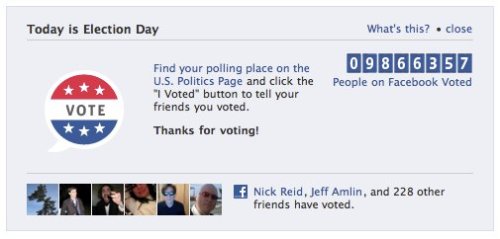
Just over a week ago I read this brief note on facebook that explains how a simple screen was used on election day to remind people to vote and asking them to click on a button if they had already voted.

Of course I couldn’t not reflect on this and how facebook is becoming a platform that promulgates openness at all levels of society. People who went out to vote just had to say they did, and others who hadn’t, saw it and were teased about their responsibility towards the nation.
What is certainly interesting is that the facebook tool combined these people’s interactions with age and political views stated on their profile. The numbers showed that a 65 year old was almost three times as likely to vote as an 18 year old, and this matched CNN’s traditional exit polls based on over 17,500 respondents coming from the voting booths. This is the thing which struck me most, and which we could certainly learn from again – almost exactly two years after Obama engaged social media and social networks to win the United States presidency.

Information, obtained through open/public data does not lie. It’s reliable. Does it follow logically that, thus, the medium which is the Internet is worth working in one’s favour all along?


Finally – a word before I close this post. This time of year is that time when Wikipedia reminds us that we all use it, and so few of us ever donate anything to keep it free. Please donate $20, $35, $50 or more by following this link. Thank you.


Google Instant.. another breakthrough for users to experience “common intelligence”.

 Google Instant was launched in the US on Wednesday.

Marissa Mayer VP for Search Products and User Experience says.. “It provides the user with an easier way to enter a query, with a lot of feedback and awsomely makes search very very efficient.”

Google co-founder Sergey Brin says “I think it’s a little bit of a new dawn in computing”.

One more intelligent step in the direction of user experience by Google! On the 30 August I wrote about the future of a child of Google and facebook. Google is the strongest search engine by far, taking 92% of  the market in te UK and 83% in the US. Facebook has over 500 million users and over 1 million websites have integrated with its platform. Yet, we have seen many a social network come and go without even a gravestone left in its memory. However encouraging these numbers may be, the future lies not with them but with whoever is innovating, making his offerings obsolete before the competiotion will. Users need products that evolve and adapt to their individual specific requirements.  The personalised experience that we as users really need is to know enough when we need to, and without having to ask for it. I call this “common intelligence”. We do not want to log in to five websites to get all the information together: we want them to talk to each other and present the information without as much as an extra click.

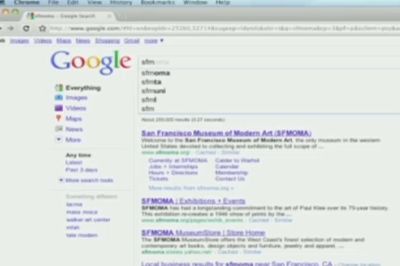
This is why Google Instant is another important step. It gets the search results out to you as you type. It is not just a drop-down box under the search box… the results page changes as you type so that San Francisco Museum comes up as the first result after the user has typed only sfm and has not yet pressed enter.

google instant

But we need yet to see more networking between Google users and the providers of Web content. Will Google (or indeed search) ever become everywhere on my Internet space? Will it be integrated with with my computer, my email and my Facebook so that, when I am writing a short message to my friends, it brings up in my Compose screen all that I need to know? As I type… “Will be in San Francisco and would love to see if there are any works by Picasso at the museum of modern art…” … will it bring up San Francisco Museum of Modern Art in a little box, a link to its website and its position on Google Maps (just in case I need attach them). I would then love it to also bring up some relevant information such as the fact that Picasso’s Les femmes d’Alger (’55) is exhibited there.

Common intelligence… isn’t it?

Learn more about Google Instant

Priority Inbox in Google’s gmail

I write about user experience all the time.. and so Google’s gmail deserves applause. The internet experience has just become better with the personalisation offered by Priority Inbox. It sifts through the emails that come in and brings forward the ones which are truly important. It learns with you and you can help it learn.

Check it out…

People always need to know more… is Facebook always going to be enough?

People in general need to know just about enough about anything that surrounds them. Some of this is called is gossip, some known as current affairs and some as networking. It makes knowledgeable people interesting. It makes it easy for this lot of interesting people to have a thousand friends on Facebook – connecting with everybody, sharing photos, making events popular by attending them and YouTube videos a success because they post them on their walls.

Facebook Creator ZUCKERBERG (Photo by Andrew Feinberg - Everystockphoto.com)

A decade ago, the Internet was nicknamed the Information Superhighway. The world talked about building an Information Society. Companies talked about how many Knowledge Workers they employed. In the world we live in, you don’t ask somebody who comes in for an interview if they have Internet at home. You don’t ask if they use email, if they’re familiar with how to write a document on a computer, or if they are on Facebook. People don’t send in typewritten CVs through the mail. They apply online, or send a PDF through email.

At the same rate that people have become more connected to the Internet, computing resources have also become ever so more accessible. Using computing power to extract intelligence has become infintely more possible. We now need not think how much such power we need: we can hook to a grid that gives us much as we need, when we need it. Virtualised computing resources, available on demand, are sometimes referred to as cloud computing. The information superhighway has become a reality not because you can Google up just about anything, but because all this data is now connected. There is also so much computing resource that we can crunch it into the useful information we need, when we need it.

So, begs the question: When will this infinite computing resource be used to connect data and people intelligently? When will this be done so that it matters not where the data is stored, what email account you used to upload it, whether you tagged that person as a friend on Facebook or whether it’s on the Googlemail contacts?

Today: You meet somebody at a party. A month or so later, you need a graphic designer and you remember that the person you met at the party was a freelance designer with her experience at one of the big publishing houses in Milan. You remember just the first name: Inga. So you go to Facebook, look up the friend who organised the party. You look up his friends, and in it you find Inga. Then you add her as a friend. When she accepts the friendship request, you can send her a message asking to meet and discuss the project.

Tomorrow: You meet Inga at the party. A month later you need a graphic designer – quick – and you think she might be interested. So you start composing a new email… “Hi Inga, we met at Mike’s housewarming party…”. Email will match which Mike in all your contacts had an event called “housewarming” to which both you and an ‘Inga’ were invited. Privacy settings permitting, email will immediately connect you with Inga and offer to add her to your contacts. Inga has shared some photos of the party which are intelligently matched with your profile picture: you are prompted to validate them and if you confirm that it’s you in the photo they will also be published to your wall.

In February’s post about Usability I wrote about digital natives who need product usability to evolve and adapt to their expectations. Facebook has stopped being innovative and, at this rate, even if it now prides 500,000-plus users, it will be replaced by any future social engine that will make it possible for information to be truly ubiquitous. The next big thing will be the Facebook that is also a Google of what I call common intelligence.

Acknowledgements: Thanks to Juan Pablo for the inspiration.

Mediaset and the freedom of TV in Italy

Starting with Canale 5 in the late 70s, the birth of Mediaset set the path for the liberalisation of the TV in Italy. Not all is clear about the situation of dominance of Mediaset in today’s Italy. The same liberalisation of the media, which was set in motion in the 80s, allows it to be publicly discussed on Italy’s television every day. 

Canale 5 and the other Mediaset Channels

TV in Italy was born in 1954, under a Christian Democrat government which led Italy between the post-WW2 years and the days of Mani Pulite (clean hands). Mani Pulite were the investigations that ran between 1992 and 1996, exposing the super-corruption nicknamed Tangentopoli (bribesville). The investigations exposed politicians from the main parties. The Christian Democrats (DC) ran Italy between 1943 and 1992 with only one major break — that between 1983 -87 when Craxi’s socialists (PSI) took power. Both Craxi and former DC prime minister Andreotti were later investigated.
 
TV has always been used by the party in power. Everybody in Italy understands the propagandist powers that the box in everybody’s living room and kitchen has. In 2005, Ambeyi Ligabo a UN expert on press freedom stated in his report on the freedom of opinion and expression in Italy, that “the public television network Rai has been strongly politicized since its creation in 1954. At the time and until the major political changes of the end of the 1980s, Italian public television was controlled by the political party in power, the Christian Democrats”.

The state-owned company Rai was the only one to hold a license to broadcast TV channels nationally. So much that when, in 1984 Fininvest acquired Rete 4 and Italia 1, Italian courts ruled that the acquisition was in breach of Rai’s right to a monopoly of simulataneous national broadcast. The courts ordered them to close doors. Craxi then rescued the situation with what many considered a rash decree which saved the Fininvest group. But that also ensured that Rai would stop being dominant.

  • It was a start of the end of the so-called lottizzazione (distribution) system of power in Rai, where the main political parties had agreed to control what went on the news and who got the top management postitions: the Christian Democrats within Rai 1, the Socialists within Rai 2 and the Communists at Rai 3. Of course, there still is lobbying and influence from government, but that’s Italy!
  • The European Audiovisual Observatory’s figures for 2008 show that the Mediaset and Rai channels together commanded over 80% of the market share. La 7, the channel owned by Telecom Italia, had a stable market share of around 3% which can be compared to the 10% of Italia 1, Rete 4, Rai 2 and Rai 3 and the 20+% of Canale 5 and Rai 2.
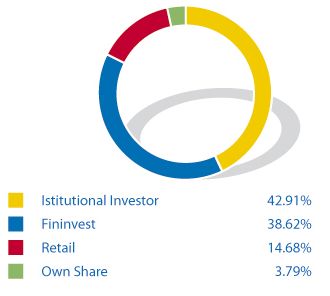
Berlusconi's Share in Mediaset: 38.62%

Are people wrong when they think that Berlusconi controls the media through his holding company: Fininvest’s share in the Mediaset group? Fininvest does not have a controlling share in Mediaset: the above chart shows it was less than 40% in Dec. 2009. In 2005 Berlusconi sold 20% of Mediaset to Kirch (10%), South African businessman Johann Rupert and the Saudi Prince Al Waleed Bin Talaal. In 1996 he continued to sell shares and relinquished control.  Today Berlusconi is an ordinary shareholder with his children Pier Silvio and Marina occupying the posts of deputy chaiman and director on the Board respectively. 

I am not drawing any conclusions. These are the facts and the rest is opinion which anybody can liberally use the media to share with whoever cares to listen.